|
(c-3c-2)
|
|
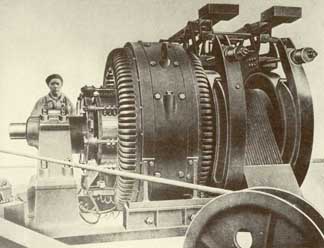
About the turn of the century, the Fraser Cable Drive momentarily
held the spotlight. Designed to obviate the disadvantages of the
great shaft space required by the winding drum machines, its hoisting
machine consisted of two motors driving a set of endless cables
by means of sheaves on their armature shafts. When both motors
ran at the same speed in opposite directions, the driving cables
moved without raising the car or counterweights. In order to start
the car, one motor was accelerated, and the other slowed down,
thus making a difference in the height of the cable loops. It
was claimed that the operator could vary his car speed from 0
to 600 fpm with "this differential drive" and that the equipment
had the advantage of compactness, rapid acceleration, quick stops
and uniform smooth movement.
(Graphic Source: ELEVATOR WORLD September 1963)
|
|
 |
(c-3c-8)
|
|
The "gearless" elevator was one of the major new developments
in elevator technology that accompanied the proliferation of high-rise
building. The first such system was installed in the Beaver Building
in New York in 1903, followed by the Majestic in Chicago a year
later. Otis Installation.
(Graphic Source: Going Up)
|
|
|
(c-3c-7)
|
|
The Jaspar Gearless elevator machines installed in the tunnel
built under the river Escaut in Northern France.
(Graphic Source: Going Up)
|
|
|
(c-3c-1)
|
|
Gearless machine by Italy's Stigler.
(Graphic Source: Raffronto fra le norme vigenti sugli)
|
|
|
(c-3c-5, c-3c-6)
|
|
Two views of the Kaestner & Hecht-Westinghouse Gearless Elevator
that represented the efforts of both concerns to produce competing
equipment in points of design, quality of workmanship and operation.
The Westinghouse company adapted its knowledge gained in allied
fields to the requirements of conditions found to be a part of
elevator service and produced gearless machines for K & H,
Guerney, A.B. See and Atlantic Elevator companies, which were
later purchased, placing Westinghouse in the high end of the vertical
transportation business.
(Graphic Source: Kaestner & Hecht Company)
|
|
|
(c-3c-3, c-3c-4)
|
|
In order to eliminate rooftop protuberances restricted by ordinance,
a number of U.K. installations are "upside down" offset driving
units. Upside down installations are engineered to be offset so
the roofline of a building would not be disturbed.
(Graphic Source: ELEVATOR WORLD October 1982)
|
|
 |